PoliticsAnalysis
Israeli election ends without a majority for either bloc, leaving coalition talks open
By Mantle News
Coverage spectrum
Covered by 3 outlets, all left-leaning.
6 articles in total, 1 of them opinion. The spectrum counts each outlet once and leaves opinion out. How we measure bias
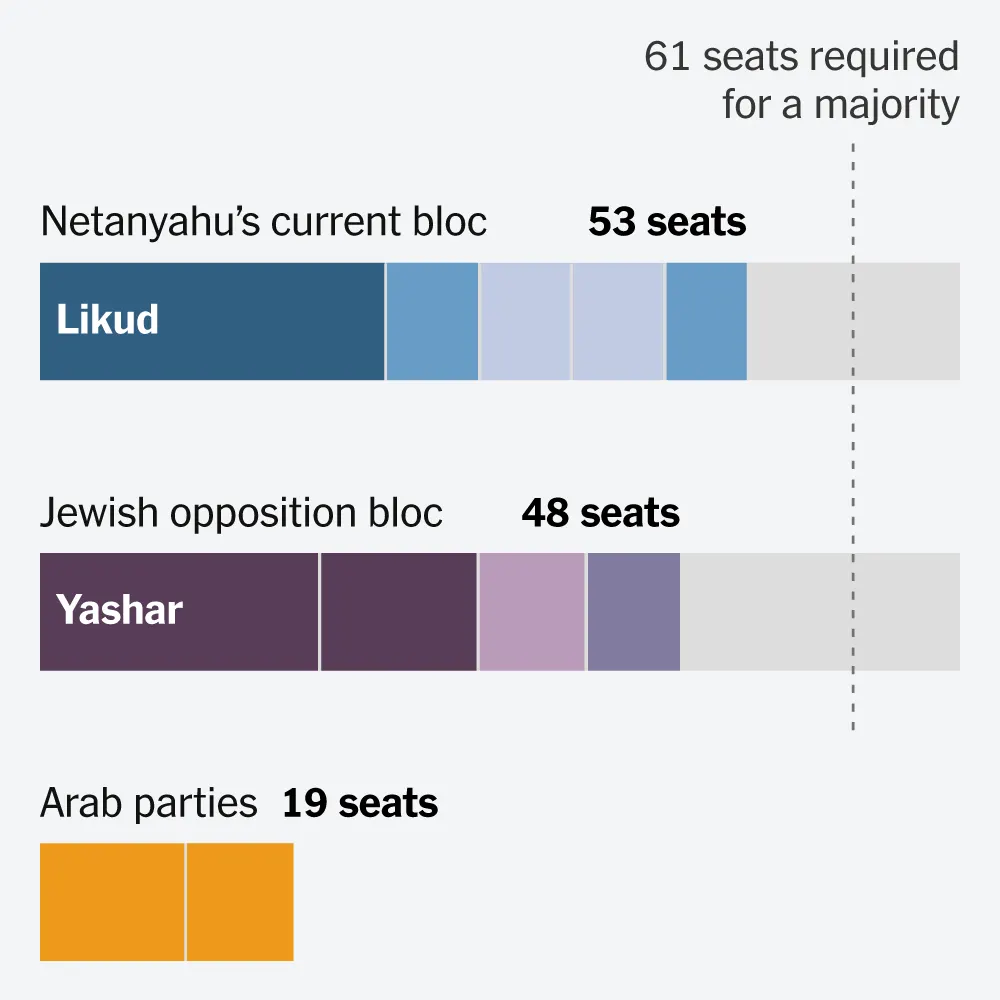
The Atlantic, The Conversation, The New York Times and Bloomberg report that Israel held a national election on October 27, 2026, and that neither Benjamin Netanyahu nor his main challenger, Gadi Eisenkot, won a majority in Parliament. The Conversation reports a turnout of 77.7 percent, the highest in more than two decades. The New York Times says possible coalitions include an opposition alliance that could involve Arab parties, and that obstacles stand in the way. Bloomberg says coalition talks could take weeks or months and would likely require difficult compromises and broken campaign promises. The Atlantic, in an opinion column, calls the result less conclusive than hoped.
Headline and summary written by Mantle’s AI from the coverage below, under published rules. How this works
What happened
Key points
Each point shows who reports it, from Far Left to Far Right.
Israel held a national election on October 27, 2026, with no clear majority for either Netanyahu's bloc or the main opposition bloc.
One side only: the leftReported byLeft2See the outletsHide the outlets
- Left
- The Atlantic, The Conversation
The Conversation reports a turnout of 77.7 percent, the highest in more than two decades.
One outletThe Conversation· Left
Neither Benjamin Netanyahu nor Gadi Eisenkot won a majority in Parliament, according to The New York Times.
One outletThe New York Times· Left
The New York Times says an opposition alliance that could include Arab parties is one possible route to a government, but it faces obstacles.
One outletThe New York Times· Left
Bloomberg reports that coalition talks could take weeks or months and would likely require difficult compromises.
One side only: the leftReported byLeft2See the outletsHide the outlets
- Left
- Bloomberg, The Conversation
How each side tells it
Compare views
All four outlets report that the October 27 election produced no majority for either Netanyahu's bloc or his main challenger, leaving coalition formation open. The coverage in this sample focuses on the process and possible coalitions, with Bloomberg stressing weeks or months of compromise.
the left
3 outlets · 1 opinion
Headlines focus on the deadlock and the process ahead, using phrases such as no clear winner, deadlock and horse-trading, with the stakes of coalition talks at the center.
With No Clear Winner, How Could Israel Get a Prime Minister?
The New York TimesLeftAll left-leaning headlines the center
No coverage yet
No center outlet that Mantle follows has covered this story yet. That absence is part of the picture.
the right
No coverage yet
No right-leaning outlet that Mantle follows has covered this story yet. That absence is part of the picture.
The words they chose
Language to notice
Words that carry a judgement beyond the facts. Tap a highlighted word anywhere on the page to see why.
Left2
willing to admithectored
Center
Has not covered this story.
Right
Has not covered this story.
In the outlets’ own words
Loaded verb
willing to admitMore neutral: than either side has said
The phrase implies that both sides are concealing their view of the result, which the piece does not establish.
…in, and they are less conclusive than everyone hoped, and than either side is willing to admit.
Used byThe Atlantic (Left)
Loaded verb
hectoredMore neutral: urged
The verb describes supporters' campaigning with a judgement of harassment rather than neutral description.
…Tel Aviv, supporters of opposition candidates drove around the main streets and hectored pedestrians and café dwellers to go vote for anyone at all who was not Netanyahu.
Used byThe Atlantic (Left)
See for yourself
Side by side
What each side leads with and what it leaves out. Open a side to read its headlines.
From the left
3 outlets · 1 opinionLeads with
- no majority for either bloc
- length of coalition talks
- possible paths to a government
See the 4 headlines from the leftHide the headlines
- BloombergLeft
What's Next for Israel After Election Stalemate?
Israel’s election deadlock has set the stage for weeks or months of political horse-trading, with every path to a government likely to demand difficult compromises and broken campaign promises. Bloomberg's Dan Williams reports. (Source: Bloomberg)
1 more from Bloomberg
With No Clear Winner, How Could Israel Get a Prime Minister?
Deadlock is possible, as neither the bloc of Prime Minister Benjamin Netanyahu nor his main challenger appear likely to win a majority. But there are still paths to a new government.
1 more from The New York Times
- The ConversationLeft
Israel has voted, but what comes next? Dissecting a messy ballot and coalition-building process
With no clear majority for the ruling coalition or main opposition bloc, working out who will form the next government could take months.
Three Scenarios for Israel
The voting results are mostly in, and they are less conclusive than everyone hoped, and than either side is Loaded verb“willing to admit”The phrase implies that both sides are concealing their view of the result, which the piece does not establish.More neutral: than either side has saidDisagree with this highlight?.
From the center
0 outletsNo center outlet that Mantle follows has covered this story yet. That absence is part of the picture.
From the right
0 outletsNo right-leaning outlet that Mantle follows has covered this story yet. That absence is part of the picture.
The stories you read build My Mix, a private picture of which sides cover the stories you choose, kept on this device. What is My Mix?
The left is Far Left and Left together. The right is Right and Far Right together. Every outlet keeps its own five-point rating.
Who reported it when
How the coverage built up
Left
First to report
The Conversation, Oct 28, 9:39 PM EDT
Center
No report yet
From the outlets Mantle follows
Right
No report yet
From the outlets Mantle follows
See the order the outlets reported inHide the order
- The ConversationLeftOct 28, 9:39 PM EDT
- The New York TimesLeftOct 29, 1:21 AM EDT
- BloombergLeftOct 29, 6:26 AM EDT
Times are the ones the outlets published in their own feeds, in Eastern time. Opinion is left out.
Read next
More on Politics
Crime & JusticeDeveloping
Reports say 2016 federal probe examined Ilhan Omar’s marriage to alleged brother
6 outletsQuiet in the center
More on Politics
PoliticsBreaking
Alaska governor orders probe into Peltola campaign over alleged same-name candidate
17 outlets
Next in today’s stories
Business & MarketsBreaking
Villa Vie Residences halts round-the-world cruise in Cambodia, citing fuel costs
20 outlets
Next in today’s stories
PoliticsDeveloping
Judge denies Justice Department request to set aside about 20,000 California ballots
23 outlets
A story one side mostly skipped
Immigration & BorderDeveloping
DHS disputes 60 Minutes segment on Texas father Moussa Diawara after his deportation
14 outletsQuiet in the center